At a Glance
- Eight-figure field services company operating across three legal entities
- Financial reporting was inconsistent, late, and unreliable — limiting leadership’s ability to make confident decisions
- Engaged Alta CFO as fractional CFO to restore financial discipline and build a reporting framework
- Within 60 days: 12+ months of data reconciled, 300+ transactions corrected, reporting errors reduced ~85%
- Cash balance increased approximately fourfold through improved collections and contract terms
- Leadership now saves ~20 hours per week previously spent reconciling conflicting data
The Situation: Growth Outpacing Financial Infrastructure
This company had done what most founders dream of — scaled into eight-figure revenue on the strength of its reputation and client relationships. The work was getting done, clients were happy, and new business kept coming in.
But behind the scenes, the finance function had not kept pace. As the organization expanded across three legal entities and multiple service lines, financial reporting became fragmented. Month-end results arrived late and lacked the detail leadership needed. Intercompany transactions were recorded inconsistently. Revenue was sometimes duplicated or misclassified. Financial records were maintained largely on a cash basis, which distorted profitability trends from one period to the next.
The result was a leadership team making consequential decisions — about hiring, pricing, and investment — based more on intuition than on reliable financial data. Management could sense the business was growing, but could not clearly identify where margins were strongest, how costs were trending, or whether working capital dynamics might constrain future expansion.
What had started as manageable accounting gaps had quietly become a strategic constraint.
The Turning Point
Leadership recognized the problem, but a traditional full-time CFO hire was not the right fit. The business needed someone who could roll up their sleeves immediately — clean up historical data, stand up reporting processes, and build a forward-looking performance framework — without the long onboarding cycle of an executive hire.
A fractional CFO engagement with Alta CFO offered the right balance: senior-level financial expertise delivered with startup-level urgency. Critically, it also provided an outside perspective shaped by working with dozens of growing service businesses facing similar challenges. Leadership could stabilize the financial foundation first, then determine what permanent finance structure the company needed.
What Alta Did
Phase 1: Financial Diagnosis
The engagement began with a detailed review of accounting practices, reporting workflows, and historical performance across all three entities. The goal was not just to identify what was wrong, but to understand why leadership had lost confidence in the numbers.
Several structural issues surfaced quickly: intercompany transactions recorded unevenly, revenue and expense allocations that did not reflect operational reality, and profitability trends that appeared inconsistent from month to month because of cash-basis distortions. Importantly, this diagnostic phase created alignment between the finance team and leadership on what needed to change and in what order.
Phase 2: Cleanup and Process Stabilization
With root causes identified, the team moved into hands-on remediation. More than 12 months of financial data was reconciled, and over 300 transaction-level discrepancies were reviewed and corrected. Intercompany balances were aligned across all three entities.
Just as critically, new processes were put in place to prevent the same problems from recurring: structured month-end close timelines, recurring reconciliation routines, and clear accountability for reporting deadlines. Leadership began receiving numbers they could actually trust.
Phase 3: Reporting and KPI Visibility
Reliable data created the opportunity to build something the company had never had: a real management reporting framework. Leadership began receiving consolidated income statements across entities, margin and cost ratio analysis, revenue performance by service line, working capital and cash flow dashboards, and budget-versus-actual tracking.
Weekly KPI dashboards replaced the old pattern of reacting to issues after month-end. Management could now identify performance risks and growth opportunities in real time, rather than piecing together information from conflicting sources.
Measurable Outcomes
Within approximately 60 days, the company’s financial posture had fundamentally shifted:
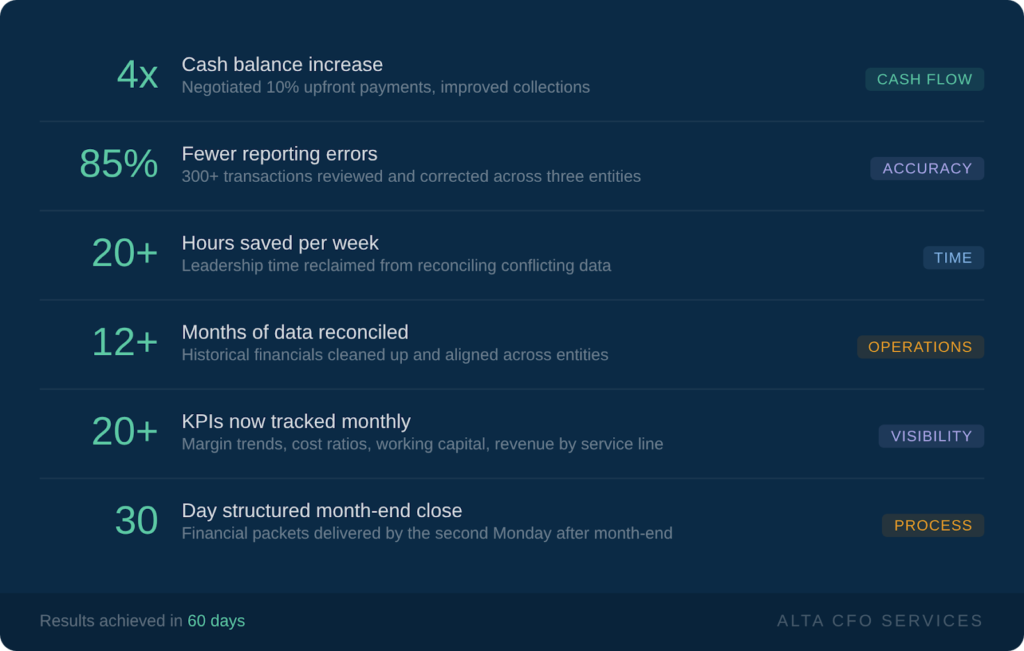
Improved financial clarity also had a direct commercial impact. With better insight into collections and contract structures, leadership negotiated 10% upfront payments on certain client engagements. The company’s cash balance increased approximately fourfold, with continued improvement expected as new terms are implemented across the client portfolio.
The Bigger Shift
The most significant change was not in the spreadsheets — it was in how leadership operated. With consistent financial visibility, management discussions shifted from reacting to past problems toward planning future performance.
Leadership can now assess which service lines generate the strongest margins and where cost structures need adjustment. Staffing decisions are grounded in data rather than gut feel. Budgeting and forecasting became more realistic. External stakeholders — including lenders — gained greater confidence in the company’s financial discipline.
As the founder put it:
“This is the only team that’s actually made finance interesting for me. I’ve never been a numbers person, but now I can clearly see what is happening in the business.”
Financial clarity became not just a reporting improvement, but a strategic capability.
The Takeaway for Growing Businesses
This company’s experience illustrates a pattern we see regularly. Commercial momentum alone does not guarantee operational clarity. As businesses scale across entities, service lines, and teams, financial complexity compounds quickly. Without structured financial leadership, even high-performing organizations struggle to interpret results and make confident strategic decisions.
The businesses that navigate this transition well are the ones that treat financial clarity as growth infrastructure — not a back-office function. When leadership has timely, accurate insight into performance, finance becomes a strategic lever that supports better hiring, sharper pricing, stronger cash management, and more intentional expansion.
Growing companies rarely fail because of a lack of opportunity. More often, they stall because leadership does not have consistent financial visibility to act on the opportunities in front of them.
If any of this sounds familiar, we should talk.
Whether you need to clean up historical financials, build a reporting framework, or simply want a second opinion on your company’s financial health — Alta CFO works with growing businesses to bring structure and visibility to their finances.